
3 Min Read
The alarm clock asks you to get up. The garage asks when the lawn will be mowed and the bikes repaired. The calendar asks to be managed. Most rooms in a home ask you to do something. The bar asks you to slow down.
For some, that means a wine collection that finally has a home worthy of it. For others, it means a place built for mixing something with intention, gathering people who matter, and giving a living space the kind of presence that makes people linger a little longer than they planned to.
What follows are a few of the bars we've built. Each one came from a different person, a different ritual, a different reason to want a room like this. Here's what we learned building them.
Temperature-Controlled Cellar
/Compelling_Homes_Ankeny_Peterson_Teresa-240523-2493.jpg?width=960&height=640&name=Compelling_Homes_Ankeny_Peterson_Teresa-240523-2493.jpg)
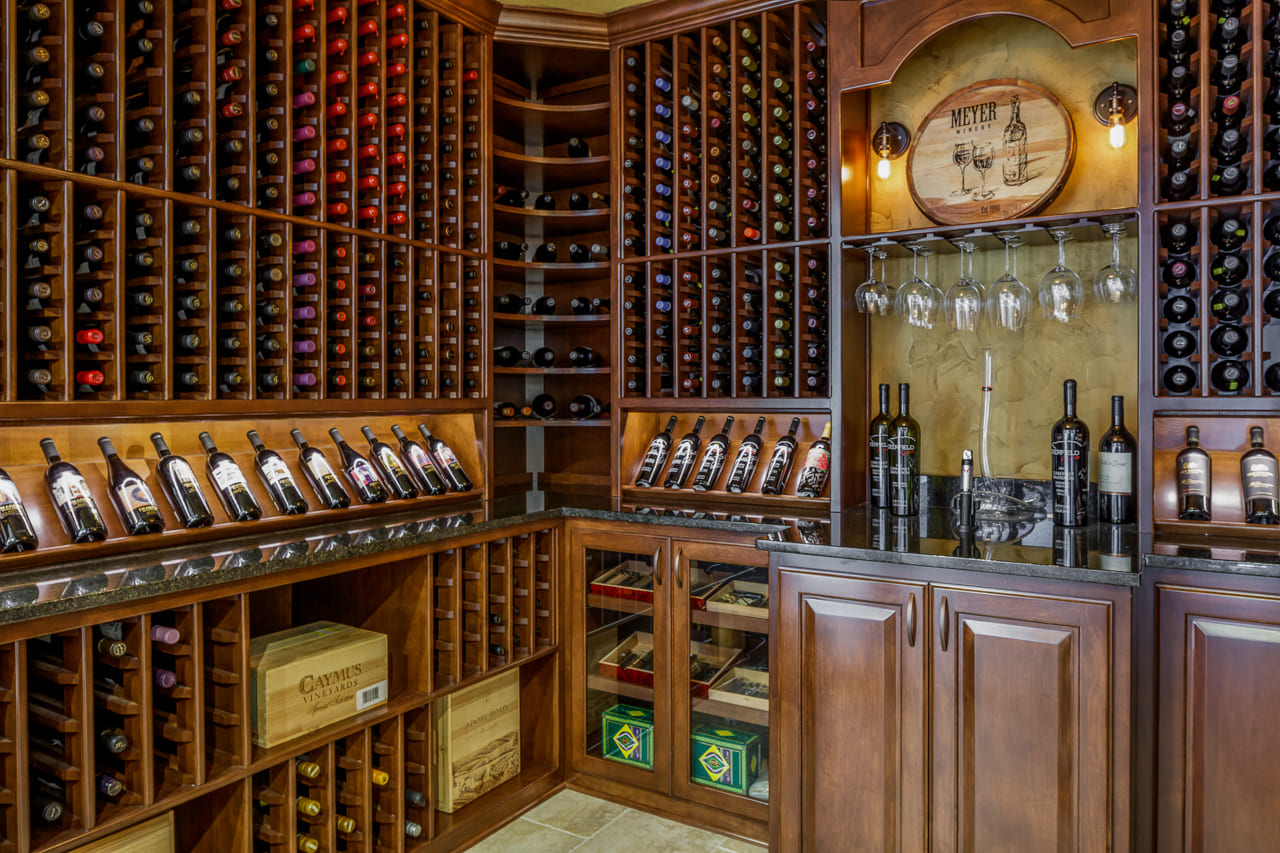
The homeowners admitted they had a wine problem the first day we met. Not as a confession — as a credential. This was our first cellar, and it still might be our most serious. Five lighting zones. Four different racking systems, because not every bottle wants to be stored the same way. A display zone for the ones worth looking at. Full temperature and humidity control, a cigar humidor, and a separate cabinet just for opening, decanting, and tasting. This is a cellar for someone with a CellarTracker login — and opinions about it.
This cellar runs quietly in the background, holding its temperature the way a good cellar should — without anyone having to think about it. The bottles sit label-out on open racks, less stored than displayed. Underfoot, a herringbone floor. Overhead, a wood-finished chandelier. Small choices, but the kind that tell you someone was paying attention to all of it.
The Basement Speakeasy
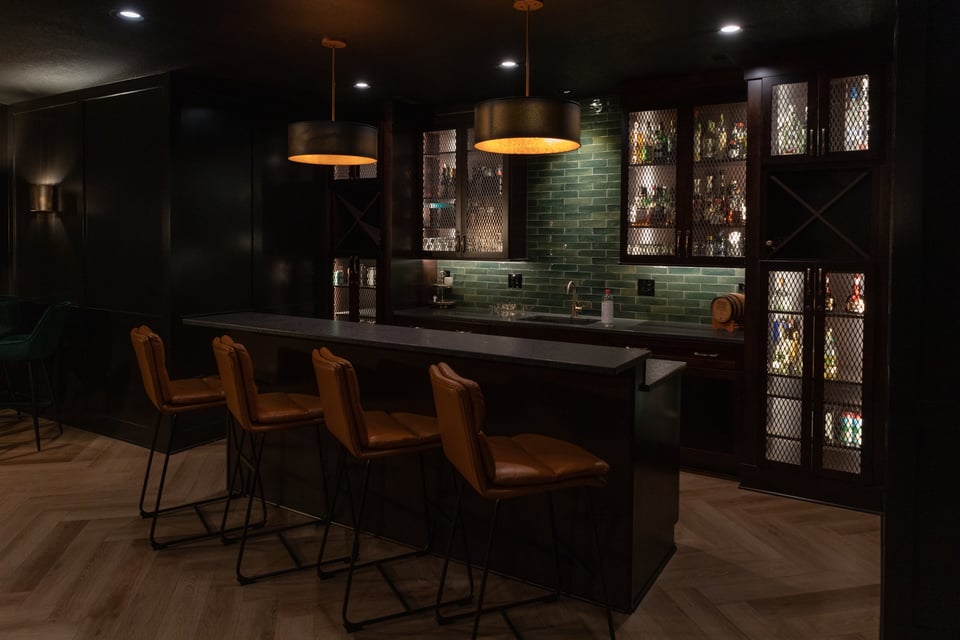
Some homeowners don't want a cellar. They want a room that feels like last call at the best bar in a city you've never been to. Dark cabinets. Dark countertops. A green brick backsplash catching just enough light. Leather stools pulled close. Glass-front cabinets hold the good stuff in plain sight — and just out of reach of smaller hands.
Nobody's speakeasy looks exactly like another. That's the point. The mood travels. The details — the brick, the leather, the light — are yours to choose.
Natural Materials
/24876%20288th%20Tr-7.jpg?width=1024&height=1280&name=24876%20288th%20Tr-7.jpg)
This client wasn't interested in clean lines or white walls. They wanted a room that felt like it grew there. The bar itself is the statement — raw wood, grain on full display, edges that refuse to be perfectly straight. Stone walls behind it add texture without competing. Pendant lights hang from a beam that's doing exactly what a beam should do.
There's room to mix a drink, plate a snack, and store the glassware that goes with both — all without feeling crowded.
High-End Open Shelving
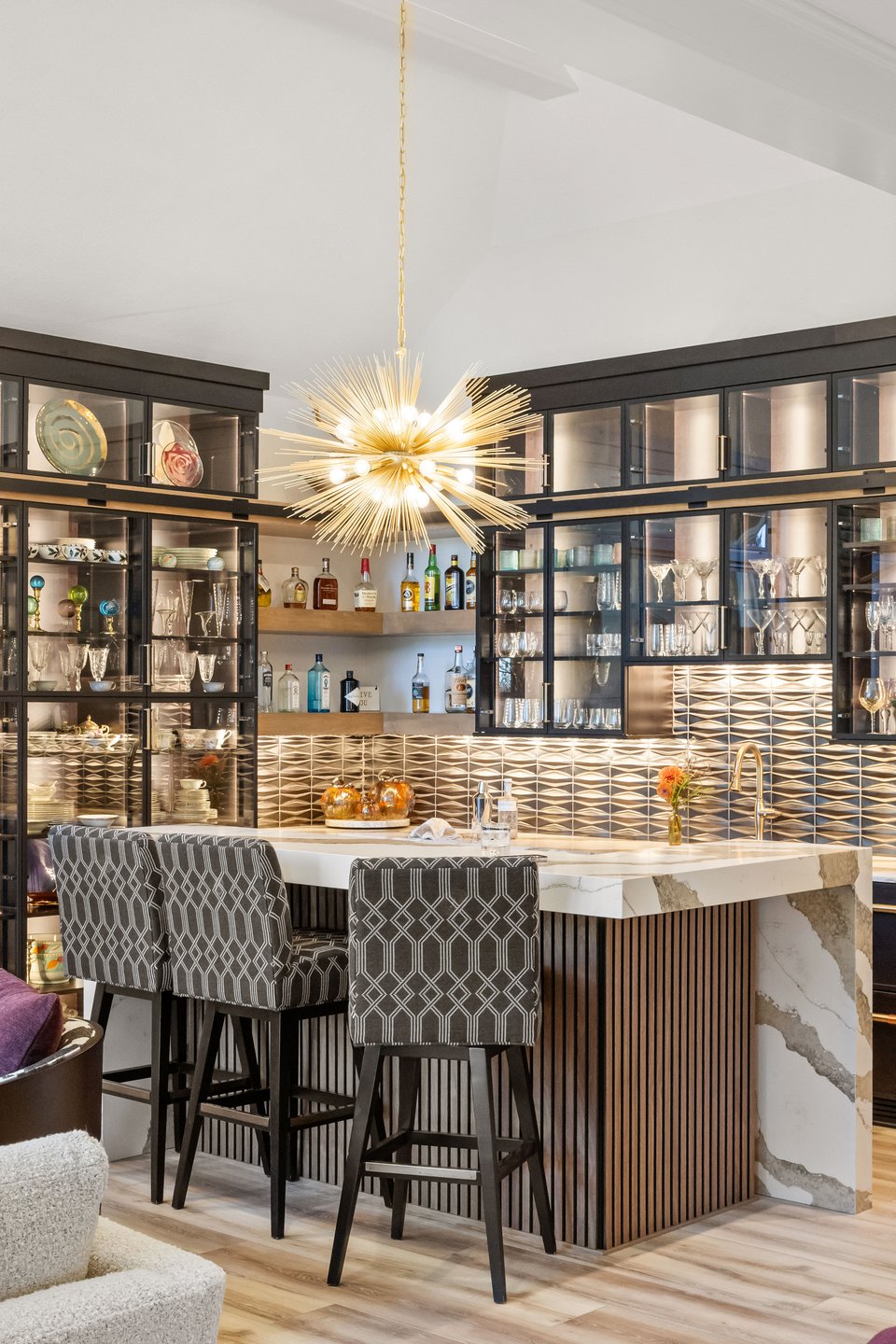
Open shelving does something different — it turns the bar into part of the room's décor, not just its function. Pattern shows up everywhere here: the backsplash, the countertop, the backs of the stools, even the chandelier overhead, all working together instead of competing.
Everything is within reach, and everything is on display — the bottles, the glassware, all of it doing double duty as decoration. It's the kind of bar that makes a Friday night feel like an occasion before anyone's poured a drop.
Kitchen Built-In Bar
/3714%20132nd%20Cir-13%20(1).jpg?width=2200&height=1472&name=3714%20132nd%20Cir-13%20(1).jpg)
Sometimes the bar doesn't need its own room — it just needs its own identity inside a room it already belongs to. In this kitchen, we gave the bar its own palette and its own hardware, distinct enough to stand apart, intentional enough to still feel like it was always part of the plan.
Whether it's pouring coffee at 6 a.m. or pouring something else at 6 p.m., a second station like this changes how a kitchen actually moves. One less bottleneck. One more reason nobody's standing in the same six square feet trying to get past each other during a dinner party.
Not every bar needs a room. This one lives in a hallway — and somehow that's exactly right. Small footprint, full intention. It works just as easily in a dining room or family room. The space was never the obstacle. It just needed the right idea.
A small counter. Closed cabinets below, open shelving above. Just enough room for a collection to live properly — and just enough surprise to make you pause for a second on your way through the main floor.
Open Basement Layout
/DSC_5479.jpg?width=960&height=640&name=DSC_5479.jpg)
Not every bar wants to be the star. This basement had room to spare, and the goal was a relaxed living space — the bar just needed to support that, not steal focus from it. A mini fridge, a sink, a microwave, enough cabinets and drawers to stay out of the way until needed.
No island here — the room stays open instead. The color tones carry through the whole basement, so nothing feels separate. A little wall art adds personality. The bar supports the room. It never tries to lead it.
A wraparound peninsula changes the gravity of a room. More counter space, sure — but more than that, it gives the bar weight. It stops being something you pass on your way somewhere else, and becomes somewhere you actually want to sit.
This layout earns its keep when space is tight. In this basement, removing the far wall would've cost more and gained less. So we kept it — and turned it into the backsplash instead. The wall didn't go anywhere. It just found a better job.
The Perfect Home Bar
Every bar on this list started the same way: Someone wanted a reason to slow down, just for a few minutes, in a room built around exactly how they live.
We don't build bars. We build the five minutes before dinner, the catch-up with a neighbor, the reason to stay a little longer.
If that's what you're after, let's talk.

.jpg?width=352&name=Compelling_Homes_Ankeny_Peterson_Teresa-240523-2689%20(1).jpg)